Showing posts with label future. Show all posts

Wednesday, 2 June 2010

Future of Educational Technology 3: Augmented Reality and ELT

In this article I want to have a quick look at Augmented Reality and what potential it holds for the future of English language teaching.

What’s Augmented Reality?

Basically, augmented reality can be defined as the interweaving of virtual Internet based materials with or physical reality. This still sounds a bit vague, so let me take this a step further. Virtual reality works with the aid of GPS (Global Positioning System) type mobile devices which are able to accurately track your physical location and they deliver to your mobile device information from the Internet which is specific to that location.
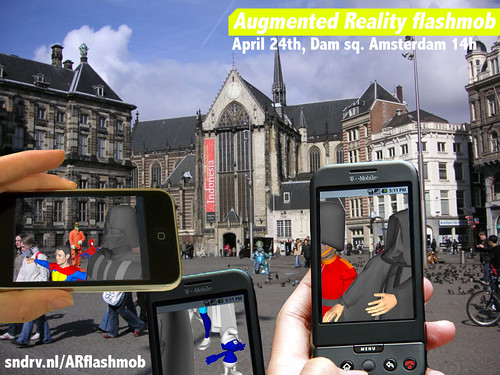
Image from Sndrv

By specific to that location, I don’t mean that if you are in London you get information about London. It’s much more specific than that. You can be tracked through your mobile device to the exact square metre on which you are standing and the information can be delivered about exactly what, or potentially who you are looking at from moment to moment.

You can see a simple video explaining augmented reality here: Augmented Reality
Most virtual reality applications at the moment are being delivered through mobile phones with cameras on, so when you hold up your mobile phone and point the camera in any direction you can see information about the things around you on your phone screen and click on the screen to get more information.
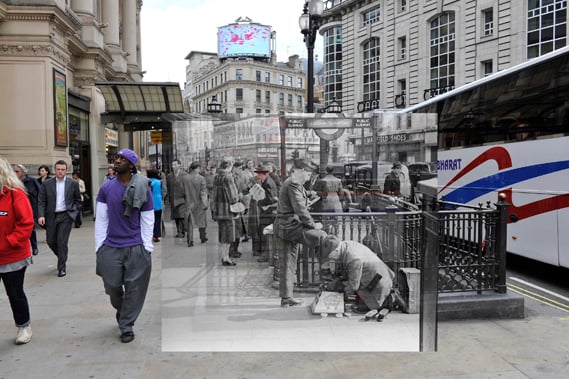
Image from PetaPixel article on AR apps for History

One marvelous example of how this can be applied is a free virtual reality App for the iPhone called Streetmuseum which has been developed by The Museum of London. It enables users walking around the streets of London to hold up their phone and get a 2D or even 3D image overlay of what that street would have looked like at some point during history.

Augmented reality in 3D can also be applied to books. You can experience this on your computer now if you have a web cam and a printer. Just follow this link to Ecomagination at http://ge.ecomagination.com, print up a simple piece of paper and follow the instructions. You’ll see a 3D animated model with sound and movements that you can actually interact with appear in front of you on your screen.

Think about how this simple piece of paper if applied to the pages of a book, could transform the experience of reading and the relationship of text to images.

How will Augmented Reality impact on teaching and learning?

  • It means that we can take learning out of the classroom and deliver it to exactly where and when students need it. 3D interactive learning materials can be delivered to students on the spot at the supermarket, train station, bank whenever they need it just through an app in their mobile phone camera.
  • Not only this but the ability of GPS to accurately track location means that you can track other users of the same app, so that if you walked into a room full of people anywhere in the world and held up your camera you would be able to see information about those people, find out which were teachers or learners of English and have your face to face lesson, or peer to peer study group with anyone and anywhere you happened to be when you had the time.

So virtual reality applications have the potential to transform our social and learning reality. They have the potential to transform the way we read and interact with text. They have the potential to transform the way and the places where we teach and the relationship between teachers and learners.

Is this something we want? Do we want to be tracked by the Internet where ever we go? Well the fact is, that if you have a GPS enabled mobile device with you right now and it’s switched on, then this is already happening to you.

As for how we as teachers deal with this and the uses it’s put to in education, that still remains to be seen, but this is happening now and we need to be aware of and start thinking about how we want this to impact on our lives and work.

Related links:
Best

Nik Peachey

Tuesday, 4 May 2010

Future of Educational Technology 2: The Web Cam

In the first of these articles on the future of educational technology I had a quick look at the Digital Divide and how continually falling prices and improving standards could help to bridge the divide. In this second article I'd like to look at the developing role of the web cam.

Video Conferencing
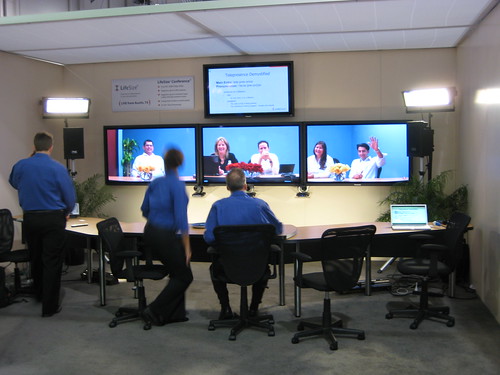
So how about the role of the humble web cam? Web cams have been around for a while now, though they don’t tend to get used so much, though there is a lot of talk about telepresence. Telepresence is supposed to be video conferencing but with such good quality it seems like the person is in the same room with you. Here’s what it looks like.

http://www.flickr.com/photos/av-1/3521310150/

Looks pretty expensive doesn’t it? I can’t say I’m impressed by this. Having used very similar equipment (probably equally expensive) and tried to have discussions between two groups of people in different rooms, I have to say that even if the quality was great it would be far from ideal.

Personally I feel that we can work just as well on our laptops with the built in web cam and a free tools like Tokbox.com. The quality that these services can offer is likely to improve over the coming years as they become more popular and attract more investment.

http://www.flickr.com/photos/mortenjust/2209302906/

Iris and Facial Recognition
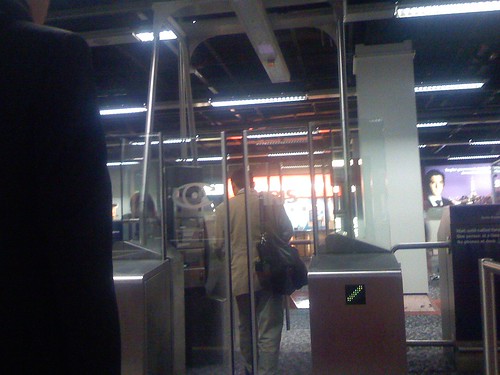
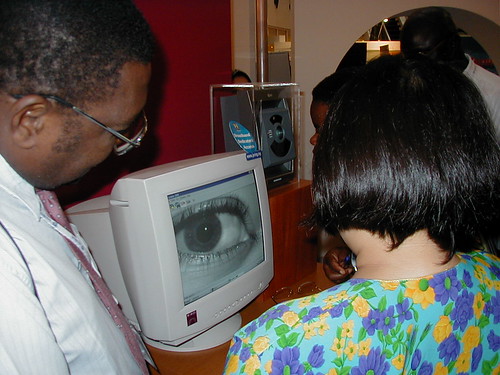
But how about this idea? Have you been through immigration at an airport recently. If you have you may have had your iris scanned as a means of identification. Suppose the technology that this system uses develops to the point where you can authenticate your identity on your computer through your web cam. So no more logging in and trying to remember user names and passwords to the sites you register on. Just sit in front of your computer and it knows who you are and unlocks all your sites and web based services for you. Possible? Useful?


http://www.flickr.com/photos/fn-goa/169836309/

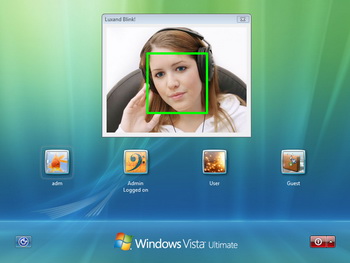
Face recognition is also becoming more common place and you can now download free software for Windows ( http://www.luxand.com/blink/)that will recognise your face and log you into your computer, so no more forgotten passwords!


Motion Recognition
Motion recognition through web cams is also making its way into games and there are already quite a few free games that you can try out using your web cam as the controller.
There are a lot more web cam controlled games available at:
http://webcamgames.sky.com/ if you feel like investigating more.

Well and what about your interactive whiteboard? What’s the connection between IWBs and web cams? Well your web cam could make the need for a specialised board and controller obsolete pretty soon if the guys at Camspace http://camspace.com/ have anything to do with it. They have been developing this system which turns any coloured object into a computer controller.


If we start applying this kind of technology to IWB software it could mean that any students in your class could hold up a pen or any coloured object and take control of the computer and write on the board from where ever they are sitting. Giving this control to students could make that interactive whiteboard a lot more interactive and better still save a lot of money.

So our web cam is not only the doorway to video conferencing and communication, it could soon also become a way of logging onto our computers and conforming our identity, a way of interacting with our computer and a way of giving students control of the board and making their interaction with the computer as a class a lot more interactive.

So that’s just a quick look at the part the humble web cam could play in the future of learning technology. I hope you enjoyed it and that it gives you some food for thought about the way technology can change the way we learn.

Related links:
Best

Nik Peachey

Wednesday, 14 April 2010

Future of Educational Technology 1: The Digital Divide

This will be the first in a series of articles I’m planning to post over the next few weeks on the topic of the future of learning technologies.

In this series I’m going to look at some trends and developments in a range of technologies and try to see how they relate to each other and how they might impact on education over the the next few years.


One of the first things I would like to focus on is the digital divide and what I believe is the ‘myth’ that technology is expensive.

Firstly, I would like to state that the digital divide hasn’t been created by technology, but by economics. It’s a financial divide that has been around for thousands of years and one that thousands of years of paper education hasn’t been able to bridge.

Here is some thing that I feel puts this in perspective though.

Past
I first bought a computer in 1997. It cost almost £2,500. It was one of the first computers with an MMX chip which meant that, as well as connecting to the Internet (by unplugging my phone and connecting the cable to my computer) at a staggering 32k, if I waited long enough I could actually download and play extremely tiny and blurry video clips. When I paid extra (quite a lot extra) for some software I was able to create text and spread sheets and if I bought some more software I could edit images and make some pictures. This computer had the same storage capacity on the hard drive as that of all the computers in the UK in 1975 put together.

Present
Ten years later in 2007 I bought an iPod Touch. It had ten times the capacity of the computer I had paid £2,500 for so that’s ten times the capacity of all the computers in the UK in 1975 combined. It fits in my pocket, connects to the Internet through wireless broadband, I can stream and watch high quality video, audio, read and create text, download literally thousands of small applications to modify the tasks it can do for me from using it as a recording studio to drum machine to games console and it cost me well below 10% of what I paid for the computer ten years earlier.


Future
If this rate of development remains consistent that means that by 2017 for around £20 I will be able to by some form of portable device that will have 100 times the capacity of all the computers in the UK in 1975 put together, carry it in my pocket, if I need to carry it at all, be able to access the biggest library of books, audio and video ever assembled in the history of humankind and create who knows what on it.
Photo credit: Scott Beale - Laughing Squid
The educational potential of such a device at that price is truly astounding, especially when you put that in perspective against the price of books. That’s approximately the same price as just one students’ text book at today’s prices.

Often when I do talks or training on technology I get at least one teacher saying something about the digital divide, as if that were a good reason for not using technology in education (We’ll be making the digital divide bigger if we do!).

This has the same logic as refusing to give your students food because some people in the world are starving! Surely what we really want is to feed everyone and to educate everyone and perhaps for the first time technology is taking us to a place where that might just be possible. Personally, I’m looking forward to 2017.

In the next post in this series I'll be looking at the humble web cam and its possible role in the future of technology.

Related links
Best

Nik Peachey